K♦ Printable PDF score sheet
Canasta & Hand and Foot
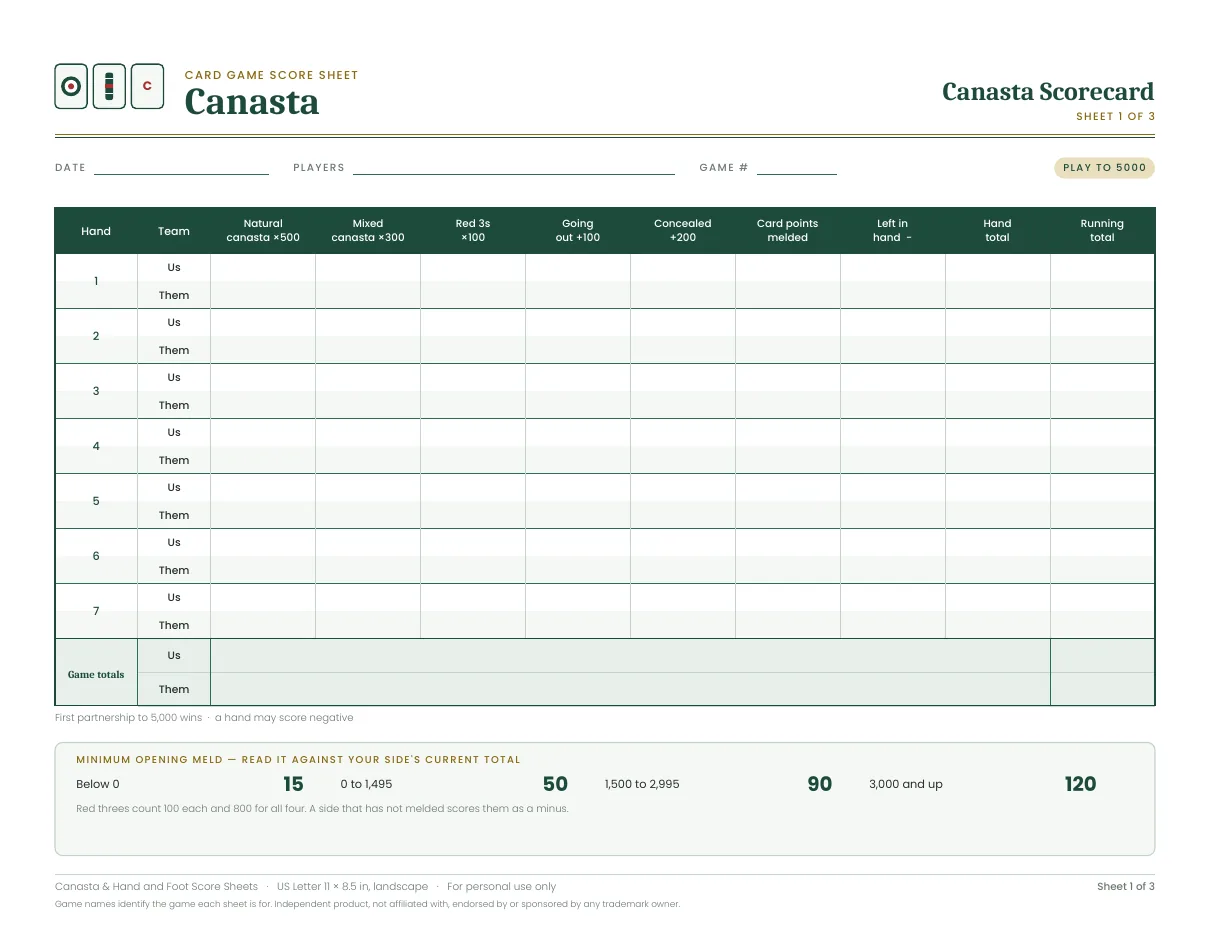
Canasta has six things to score every hand and an opening meld that changes as your score climbs. This sheet puts all of it on the page, so the person keeping score is not doing arithmetic from memory.
Customize and buy Add your group's name, pick a color, download straight away.
What you get
- Canasta scorecard Seven hands, one row per partnership, with a column for each thing that scores. The opening meld table sits under the grid.
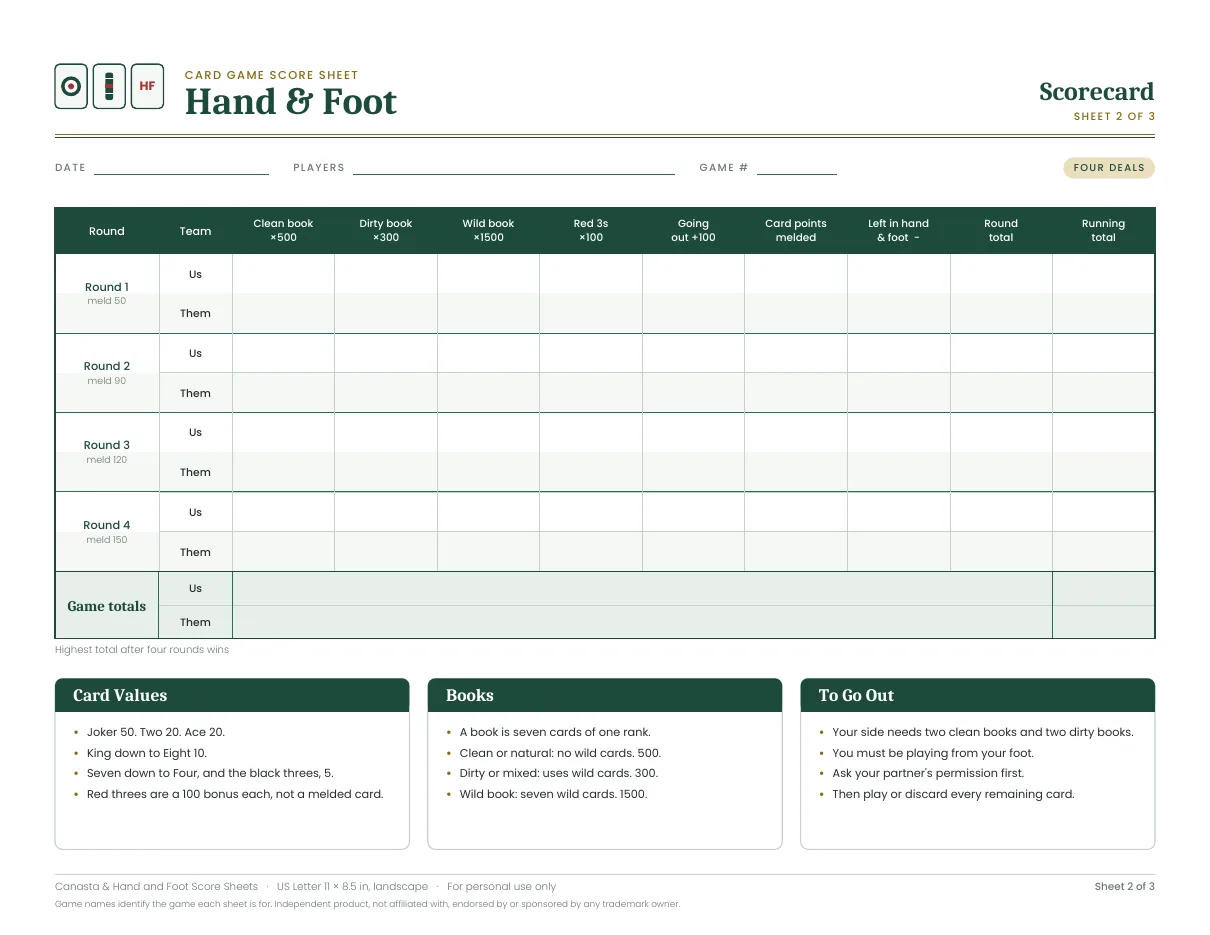
- Hand and Foot scorecard Four rounds, and every round already shows the meld you need to open it.
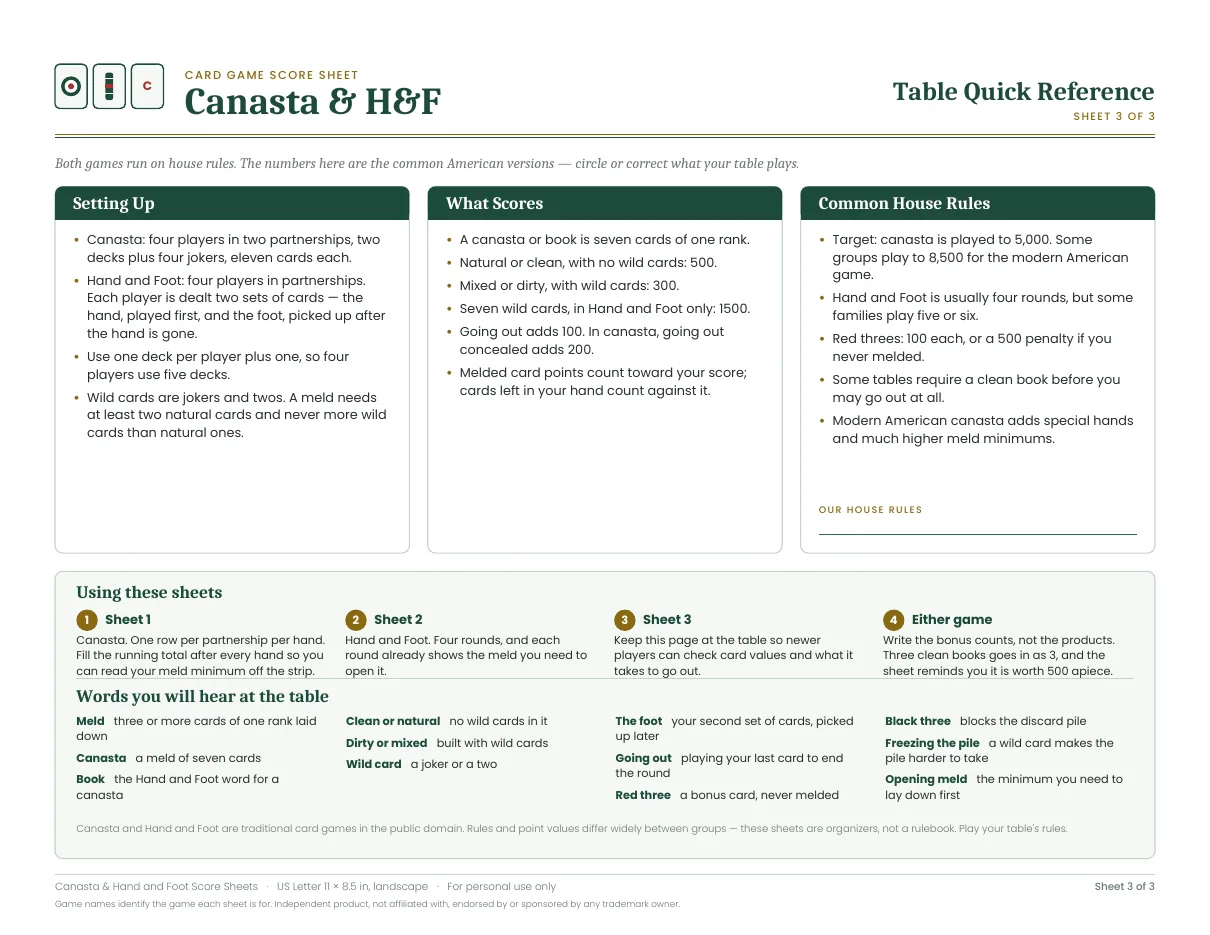
- Table quick reference Card values, what counts as a book, what it takes to go out, and a glossary for newer players.
- Five colors Jade, navy, burgundy, slate and blush, all in the one download.
- Your group's name Optional, printed in the header and footer of every sheet.
- Large print option Bigger type on the sheets you write on, for easier reading at the table. Same price.
3 sheets · US Letter landscape, 11 × 8.5 in · vector PDF, sharp at any size · prints in color or grayscale
How canasta scoring works
Each hand, a partnership scores the cards it melded, plus bonuses, minus whatever is still in hand when someone goes out.
A canasta is a meld of seven cards. A natural or clean canasta, with no wild cards in it, is worth 500. A mixed or dirty canasta, built with wild cards, is worth 300.
Going out adds 100. Going out concealed, having melded nothing until that moment, adds 200 instead.
Red threes are worth 100 each, and 800 if one side collects all four. A partnership that never melded counts them against itself rather than for itself.
Play continues hand after hand until a partnership reaches 5,000.
The opening meld is the part people get wrong
Your first meld of each hand has to reach a minimum, and that minimum depends on your partnership's current total. It goes up as you win.
Below zero, you need 15. From zero to 1,495 you need 50. From 1,500 to 2,995 you need 90. At 3,000 and above you need 120.
That table is printed under the scoring grid, so you read your requirement straight off your running total.
What Hand and Foot does differently
Each player is dealt two sets of cards. You play the hand first, and pick up the foot once the hand is gone.
The game is four rounds rather than open ended, and each round has its own opening meld: 50, then 90, then 120, then 150.
Sevens of a kind are called books. Clean books are 500, dirty books are 300, and a book of seven wild cards is 1,500.
To go out, your side needs two clean books and two dirty books, you have to be playing from your foot, and you ask your partner's permission first.
House rules
Both games vary a lot between groups. Some play canasta to 8,500 for the modern American version. Some play Hand and Foot in five or six rounds. Some treat unmelded red threes as a 500 penalty rather than 100.
The reference sheet has a blank line for writing down what your table plays, and the numbers on it are the common American versions rather than the only ones.
Large print
Check the large print box when you customize and the scoring grid comes out with noticeably bigger type and taller rows, which most people find easier to read across a table.
The grid is what grows. Reference panels and the fine print stay at their normal size, so nothing gets squeezed off the page, and the sheet still holds a sensible number of rounds.
Questions
- How many players?
- Four, in two partnerships, for both games.
- What size does it print?
- US Letter, landscape. It also prints on A4 if you set your printer to fit to page.
- Can I print it more than once?
- Yes. One download, print as many as your group needs, for as long as you play.